Your Next Phone Will Have Less RAM Than Your Current One — And Cost More
Published: December 16, 2025
I’ve been covering tech long enough to recognize when the industry hits an inflection point. This is one of those moments.
Your Next Phone Will Have Less RAM Than Your Current One — And Cost More

By mid-2026, entry-level smartphones will ship with 4GB of RAM Specification I genuinely thought we’d retired alongside headphone jacks and removable batteries. Mid-range phones currently shipping with 12GB? They’ll drop to 8GB. And flagship devices that should be pushing toward 16GB will stagnate at 12GB.
Here’s the part that stings: you’ll pay 5–7% more for these downgrades.
The Crisis Nobody Saw Coming
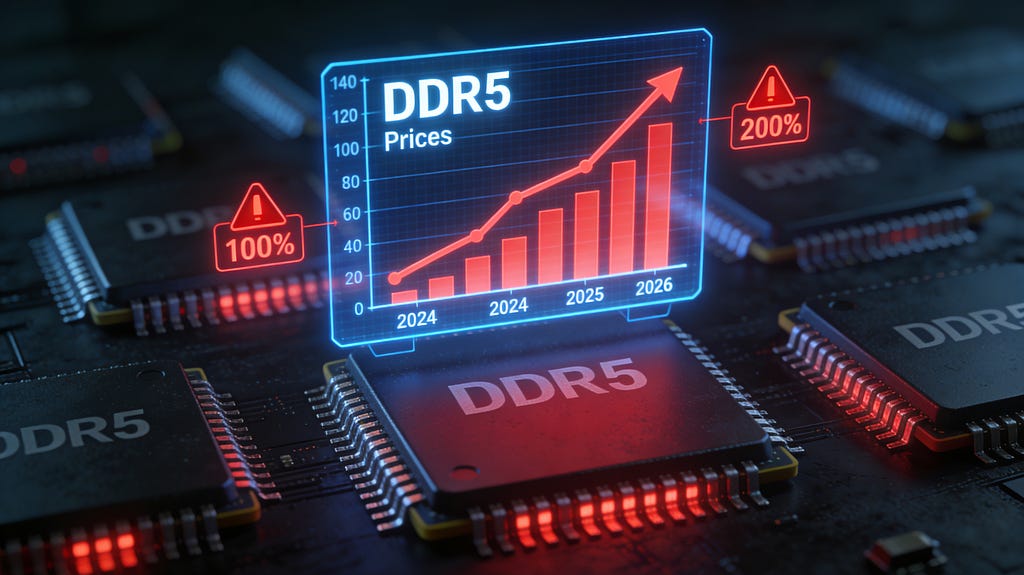
Samsung just raised DDR5 contract prices to $19.50 per unit — more than 100% higher than earlier pricing. For context, that’s the memory chip that goes into your phone. A 16Gb DDR5 chip that cost $6.84 in September now averages $27.20.
I watched RAM prices for my own PC builds. A 32GB DDR5 kit that sold for under $150 in mid-2025 has climbed to around $184. Some kits have tripled in price in eight months. This isn’t just inconvenient for enthusiasts — it’s devastating for smartphone manufacturers operating on razor-thin margins.
The real kicker? Leading analysts now warn that high memory prices and tight supply could persist into 2027–2028 when new fabrication plants come online. We’re looking at three years of this.

What Actually Caused This
Three letters: A-I
AI data centers are consuming memory production capacity at an unprecedented rate. Companies like Microsoft, NVIDIA, and Meta are stockpiling high-bandwidth memory (HBM) for their AI accelerators. Memory prices have swung sharply upward through 2024–2025, with DRAM spot prices nearly triple their level of a year earlier by Q4 2025.
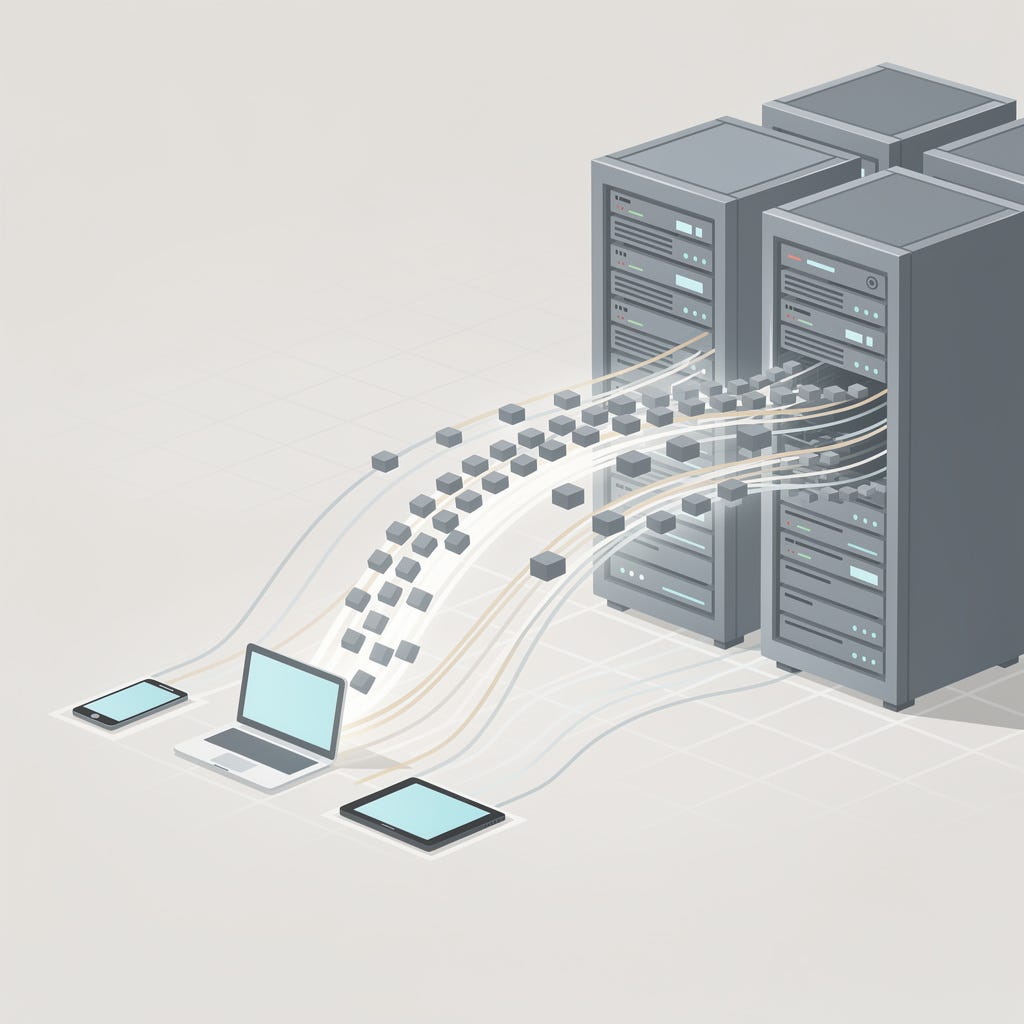
The memory oligopoly — Samsung, SK Hynix, and Micron — face a choice: produce commodity DRAM for phones and PCs, or manufacture HBM for AI companies willing to pay premium prices. They’re choosing profitability.
Memory manufacturers are content with higher margins per chip rather than flooding the market. New DRAM fabrication plants won’t provide relief until late 2027 or beyond. In my experience covering hardware cycles.
This is textbook manufactured scarcity with legitimate demand overlay.
The Downgrade Timeline
Here’s what you need to know about 2026 smartphone specifications:
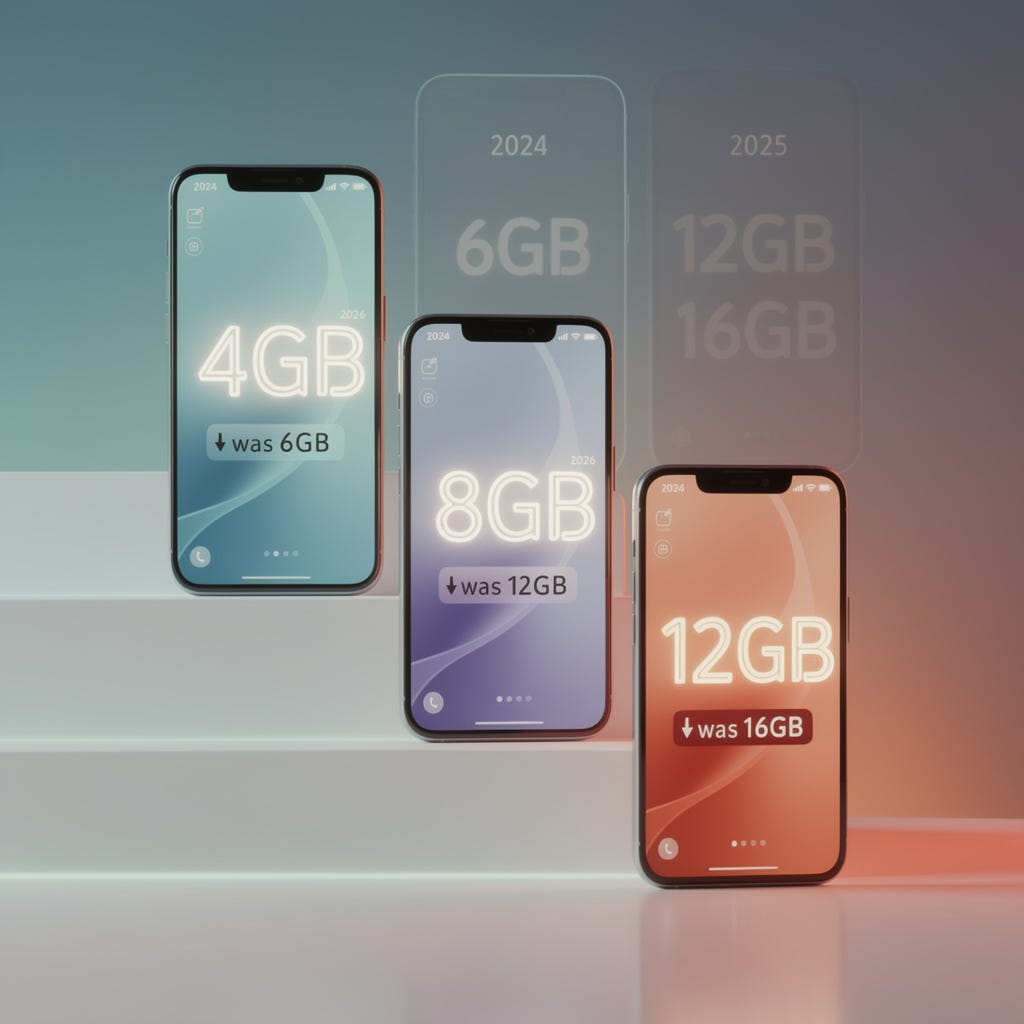
Entry-Level Phones: Base models are expected to see a return of 4GB RAM in 2026. That’s the same memory configuration we had in 2018. Your budget Android will struggle with basic multitasking.
Mid-Range Devices: Manufacturers will cut DRAM capacities down to minimum standards. Phones that currently offer 12GB as a selling point will max out at 8GB. The upgrade cycle slows significantly.
Flagship Phones: Apple faces pressure as memory is expected to “significantly increase” as a share of the iPhone bill of materials in early 2026. Don’t expect meaningful RAM upgrades when each GB costs manufacturers substantially more.
I’ve tested dozens of smartphones over the years. The difference between 8GB and 12GB isn’t just numbers on a spec sheet — it’s whether your phone can keep apps in memory or constantly reloads them. We’re regressing.
The Silver Lining Nobody Expected

Here’s where it gets interesting: smartphone makers are toying with the idea of bringing back the micro-SD card slot, possibly in 2026.
I never thought I’d write that sentence again.
The economics make sense. Samsung’s P9 Express 512GB cards, rated up to 800 MB/s, sell for $74.99, whereas upgrading internal storage on some brands can run up to $200.
Users can buy base storage configurations and expand externally, manufacturers save on bill of materials costs, everyone wins.
Well, sort of.
The micro-SD slot’s return isn’t some magnanimous gesture toward consumer choice. It’s cost-cutting dressed as a feature. The first models with a restored slot are expected in the second half of 2026, likely using hybrid SIM/micro-SD trays to avoid redesigning phone bodies.
What most people miss: this represents a fundamental admission that the “cloud-first, soldered-storage future” manufacturers pushed for years was always about margin expansion, not user experience.
Who Gets Hurt Most?
Apple: The company’s legendary supply chain prowess won’t save it this time. Memory costs are climbing faster than Apple can negotiate. Expect either price increases or unchanged prices with stagnant specifications. My money’s on both — higher prices for Pro models, static specs for base models.
Android Mid-Tier: Smartphone makers aiming at mid-to-low-end segments, where RAM is a crucial marketing differentiator, will need to raise launch prices of new smartphones in 2026. Companies like Xiaomi, Oppo, and Realme compete on value propositions. That value proposition just evaporated.
PC Builders: Major PC makers have signaled they will raise PC prices by 15–20% in early 2026 as memory costs surge. A 64GB DDR5 kit now tops $500, which is more expensive than a Sony PlayStation 5.
The ripple effects extend everywhere. Even the Nintendo Switch 2 can’t escape — Nintendo has seen a 4.7% dip in stock price, much of which relates to rising RAM costs.
When Does It End?
Not soon.
Micron’s new DRAM facility in Japan won’t ship until late 2028. Building memory fabrication plants takes years. Supply won’t normalize before 2027–2028 at the earliest.
December contract prices of some categories of DRAM and 3D NAND increased 80% to 100% month-on-month. That’s not a typo. Month-on-month. We’re in uncharted territory.
What You Should Do
I’m going to give you the advice I’m following myself:
If you need a new phone, buy it now. Current inventory was manufactured when memory was cheaper. Overall BOM costs will grow by an additional 5–7% in 2026 compared to 2025. The phones available today have better specifications than what’s launching next year.
Keep your current device longer. Your 2024–2025 phone is legitimately better specs than most 2026 models will be. The upgrade cycle math has completely inverted.
Embrace the micro-SD comeback — if it happens. A 512GB micro-SD card for $75 beats paying $200 for a storage tier upgrade. This assumes manufacturers actually follow through.
Consider refurbished flagships. A 2024 flagship with 12GB RAM beats a 2026 mid-ranger with 8GB RAM. The secondary market suddenly looks much more attractive.
The Broader Context
I want to zoom out for a moment.
This crisis reveals something uncomfortable about how the tech industry operates. For years, we were told that removing micro-SD slots, soldering RAM, and eliminating upgradability were necessary innovations. Phones needed to be thinner, more water-resistant, more integrated.
That was never the full story. Those decisions were about controlling the upgrade path and capturing revenue that would otherwise flow to third-party accessory manufacturers.
Now, facing genuine supply constraints, those same manufacturers are considering reintroducing features they spent a decade convincing us were obsolete. The honest truth? Consumer flexibility was always technically feasible. It just wasn’t profitable.
The DRAM industry is an oligopoly of basically three major players: Samsung, SK Hynix, and Micron. When only three companies control global memory supply, any coordinated behavior — explicit or tacit — has outsized market impact.
After bleeding financially during the last oversupply downturn, the major DRAM makers are now seeing record-high earnings in Q3 2025 thanks to the price surge. The shortage is phenomenally profitable.
The Irony of Progress
We’re watching technology regress in real-time.
Phones are getting thicker (for larger batteries), bezels are returning (for cost savings), and now RAM configurations are reverting to 2018 specifications. Meanwhile, prices climb. The trajectory we were promised — cheaper, faster, better — has inverted.
The AI boom that’s supposed to revolutionize how we interact with technology has instead made the devices we use every day worse and more expensive. Your smartphone can’t run advanced AI models locally without sufficient RAM, but you can’t get sufficient RAM because AI data centers are consuming production capacity.
It’s almost poetic.
The Uncomfortable Truth
2026 will be remembered as the year the smartphone industry went backward while charging forward prices.
This isn’t about temporary supply chain disruptions. This is about fundamental misalignment between where memory production capacity is being allocated (AI data centers) and where most people need it (consumer devices). The market is “working” exactly as designed — capital flows to the highest returns. Those returns currently come from AI companies, not from you.
The micro-SD slot’s potential return won’t fix this. It’s a Band-Aid on a structural problem. What we’re witnessing is the beginning of a multi-year period where consumer technology stagnates while enterprise AI infrastructure advances.
I’ve covered enough boom-and-bust cycles to recognize the pattern. Memory prices will eventually stabilize. New fabs will come online. Supply and demand will find equilibrium. But that’s 2028 at the earliest.
Until then, we’re in for a rough ride.
The RAM crisis affects every device category. I’ll be tracking price developments and specification changes as 2026 unfolds. If you found this analysis useful, consider following for updates as this situation develops.
