Mozilla’s AI Browser Pivot Isn’t About Innovation, It’s About Survival (And That’s the Problem)
Published: December 17, 2025
I’ve been covering browsers, privacy tech, and open-source software long enough to recognize a familiar pattern.
Mozilla’s AI Browser Pivot Isn’t About Innovation, It’s About Survival (And That’s the Problem)

When a company says it’s “evolving” into something users never asked for, it’s usually not chasing a bold vision. It’s trying to outrun irrelevance.
That’s exactly how Mozilla’s announcement landed.
On December 16, 2025, Mozilla appointed Anthony Enzor-DeMeo as CEO of Mozilla Corporation. Almost immediately, he framed Firefox’s future as a “modern AI browser.” Within hours, Reddit and developer communities erupted. Not with curiosity — but with genuine anger.
One top comment summed it up brutally:
“I’ve never seen a company so astoundingly out of touch.”

After reading the announcement, the backlash, and Mozilla’s own justifications, I don’t think this reaction is about hating AI.
It’s about trust. And Mozilla is spending it faster than it realizes.
Nobody Asked for an AI Browser — Especially Firefox Users
If you want to understand why this blew up, you need to understand
Why do people still use Firefox?
In my experience, Firefox users aren’t passive consumers. They’re intentional. They switched away from Chrome for specific reasons: privacy, control, extensibility, and a refusal to be dragged into Google’s ecosystem.
So when Mozilla said “AI browser” people didn’t hear innovation. They heard betrayal.
The highest-upvoted reactions weren’t nuanced critiques. They were visceral:
- “What does an AI browser even mean? I want it to open websites and let me use uBlock.”
- “Feels like nobody asked for this.”
- “I am so sick of this AI garbage being shoved everywhere.”
This isn’t casual complaining. This is a user base signaling identity misalignment.
Firefox wasn’t just another browser. It was the alternative.
Firefox’s Value Was That It Didn’t Chase Trends

For years, Mozilla’s strongest differentiator wasn’t speed benchmarks or features. It was philosophy.
Firefox stood for:
- User agency
- Privacy by default
- Open standards
- A non-Google vision of the web
I’ve personally recommended Firefox to friends and teams not because it was flashy, but because it was principled. You could feel that intent in the product.
That’s why comments like this sting:
People use Firefox literally because it wasn’t going the same way Chrome was. Why take away the good parts?
Mozilla isn’t losing users because it lacks AI.
It’s losing users because it’s starting to sound like everyone else.
So What Does “AI Browser” Actually Mean?
Mozilla insists this isn’t about forcing AI down anyone’s throat.
According to Enzor-DeMeo, Firefox’s AI future is built on three pillars:
- User agency
- Transparent data usage
- Trust-aligned business models
On paper, that sounds reassuring.
In practice, the announced features include:
- AI-powered content summarization (already live on iOS)
- An optional “AI Window” assistant
- Smarter search and personalization
- User choice over which AI model to use
None of this is inherently evil. Some of it is even useful.
But here’s the part most people miss:
Features don’t exist in a vacuum. Incentives shape products.

And Mozilla’s incentives have changed.
The Real Reason Mozilla Is Doing This: Money
Let’s drop the pretense.
Mozilla’s business depends heavily on its Google search deal. That deal is increasingly fragile in a world where users obtain answers from chatbots rather than search boxes.
At the same time:
- Firefox holds roughly 2.3% global browser market share
- Chrome dominates with over 70%
- Safari and Edge continue to grow
- New AI-first browsers are attracting attention and funding
In that context, an AI pivot isn’t bold. It’s defensive.
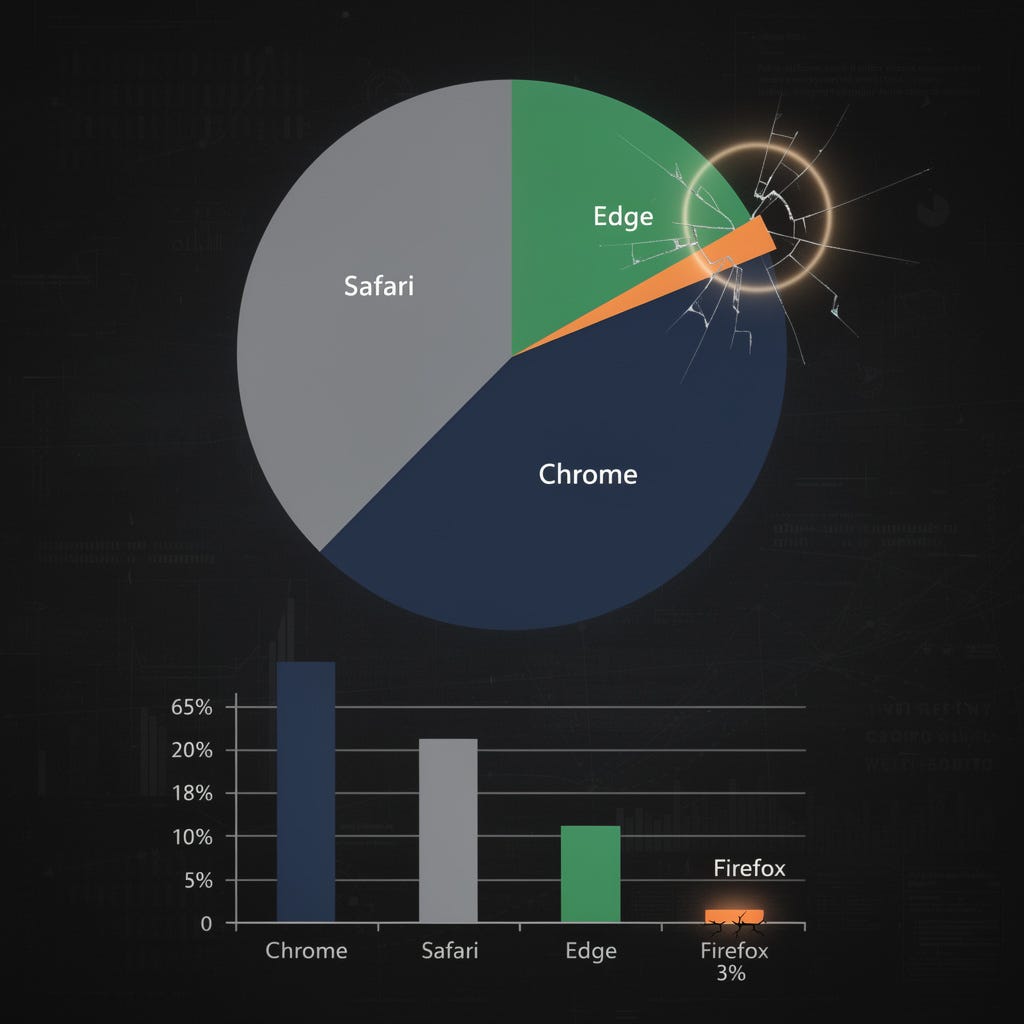
Mozilla calls it a “double bottom line” — mission plus, market success.
Translated into plain English:
AI revenue is non-negotiable.
And that’s where the trust problem starts.
“You Can Turn It Off” Is Easy to Say — Hard to Believe
Mozilla keeps emphasizing that AI features will be “easy to turn off.”
I’ve heard this promise before — from Google, Microsoft, Meta, and just about every platform that later buried the off switch three menus deep.
If AI becomes a meaningful revenue stream, how optional will it really be?
- Will there be a single toggle?
- Or a maze of settings?
- Will defaults quietly change over time?
- Will enterprise policies be required to fully disable it?
When revenue depends on usage, friction becomes strategy.

Mozilla may not intend to cross that line. But history suggests intentions don’t survive quarterly pressure.
What’s Already Live (And Why It Matters)
To be fair, Mozilla isn’t starting from zero.
They’ve already shipped:
- “Shake to Summarize” on iOS (which earned a TIME Best Inventions mention)
- A fully optional AI Window with model choice
- Strong growth in Firefox mobile usage over the past two years
This matters because it shows Mozilla can ship AI responsibly.
The question isn’t whether they can do AI.
It’s whether they can do it without becoming what users are running from.
This Isn’t Just About Firefox — It’s About Open Source Reality
Firefox is the last major independent browser not controlled by a Big Tech giant.
That makes this moment bigger than Mozilla.
If Firefox can’t survive without compromising its principles, what does that say about:
- Open-source sustainability?
- Privacy-first software at scale?
- Alternatives to ad-driven surveillance models?

Mozilla’s AI pivot may become a blueprint — or a cautionary tale — for every open project trying to balance ideals with payroll.
What Users Want vs. What Mozilla Needs
Here’s the uncomfortable truth.
Users want:
- A fast, lightweight browser
- Strong privacy defaults
- Full uBlock Origin support
- No AI clutter
- A real alternative to Chrome
Mozilla needs:
- Revenue beyond Google
- Features people will pay for
- Competitive parity with AI-driven rivals
- Relevance in a changing web
- To survive
Both sides are rational.
They’re just not aligned.
My Take: This Is a High-Risk Bet, Not a Visionary One

I don’t think Mozilla is evil.
I don’t think Enzor-DeMeo is incompetent.
And I don’t think AI is inherently bad.
But I do think Mozilla is gambling with the one asset it can’t replace: user trust.
Firefox didn’t win by being exciting.
It won by being dependable.
If Mozilla turns Firefox into “Chrome, but with nicer messaging,” the market won’t reward it. Users will just leave — quietly, permanently, and without drama.
The most telling Reddit comment I saw wasn’t angry. It was resigned:
“At some point, I wonder if enshittification is the goal, not the side effect.”
That’s the sentiment Mozilla needs to fight — not with slogans, but with restraint.
Because in a world obsessed with adding more AI, the boldest move might be knowing when not to.
